18 Nov
2026
LUANAR Partners with Local Agro-Processor to Drive AI Innovation in Malawi's Food Industry
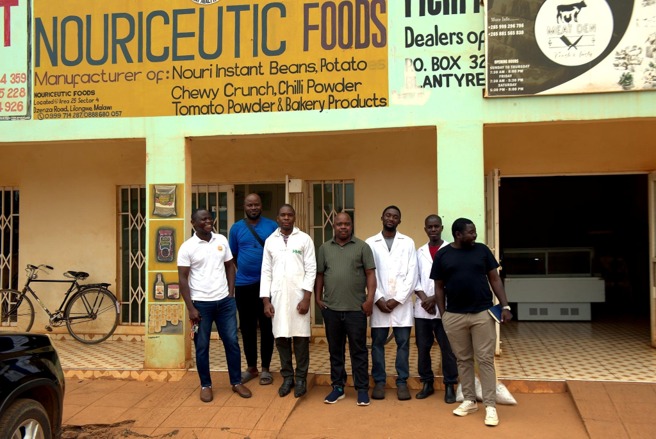
LILONGWE, Malawi — Researchers from the Lilongwe University of Agriculture and Natural Resources (LUANAR), led by Principal Investigator Dr. Ruth Magreta, have launched an artificial intelligence initiative in partnership with local food processing enterprise Nouriceutic Foods.
The research is part of the OPTIMAR-AI project (Optimizing Industry Operations in Malawi and Rwanda with AI-Driven Recommender Systems and Deep Learning), implemented in collaboration with the University of Rwanda and supported by the Africa Centre of Excellence in Agricultural Policy Analysis (ACE II–APA).
Bridging Industrial Gaps in Local Agro-Processing
Established in 2023 in Lilongwe, Nouriceutic Foods produces value-added food items such as Orange-Fleshed Sweet Potato (OFSP) buns and puree products, operating production sites in Area 25 and a retail outlet in Area 49. However, like many emerging agro-processing enterprises in Malawi, the business has historically relied on manual inspection, experience-based demand planning, and spreadsheet records to manage production schedules, inventory, and quality assurance.
To modernize operations and minimize post-harvest spoilage, the OPTIMAR-AI team conducted an operational needs assessment focusing on Nouri Instant Beans—a Malawi Bureau of Standards (MBS)-certified flagship product selected due to its strategic importance for market expansion and its susceptibility to contamination and spoilage risks.
AI-Powered Food Safety and Demand Forecasting
The OPTIMAR-AI project is introducing tailored digital solutions to address critical operational bottlenecks:
- Computer Vision for Contamination & Moisture Detection: The team is developing deep learning computer vision models to detect foreign materials, mould, packaging defects, and moisture irregularities during processing and storage. Because improper moisture control is a primary trigger for microbial growth and spoilage, real-time AI visual inspection provides an early warning system before product quality is compromised.
- Machine Learning Demand Forecasting: Moving away from reactive, order-by-order scheduling, machine learning models will analyze historical production, sales, and procurement data to accurately predict market demand. This ensures Nouriceutic Foods can optimize daily production (currently averaging 40 to 80 packs per day) while preventing stockouts or excess inventory accumulation.
- Integrated Operational Dashboard: A centralized digital dashboard will consolidate real-time data across raw material sourcing, inventory levels, quality alerts, and sales performance, empowering management to make swift, data-driven decisions.
Supporting the Malawi 2063 Vision By transitioning local agro-processors from manual oversight to automated, data-driven decision-support systems, the OPTIMAR-AI initiative aligns directly with the Malawi 2063 national development agenda, which prioritizes industrialization, agricultural commercialization, and digital transformation. "Effective digital transformation begins with a clear understanding of existing operational practices," the research team highlighted in their assessment, emphasizing a phased implementation approach that combines digital skills training for local staff with scalable technology deployment. The success of the Nouri Instant Beans pilot will serve as a model for scaling AI-driven operational tools across other food manufacturing sectors in Malawi and Rwanda.